South Wales is full of beautiful historic sites and even more beautiful coastline. You'll start your journey exploring the historic walled city of Tenby and its vast sandy beaches. You'll move on to the city of Swansea on Swansea Bay with its shell-rich beaches and the most beautiful sunsets. You will then walk along the south coast of one of the most beautiful protected areas - the Gower Peninsula.
Turn to the capital city of Cardiff to explore the city, the castle and the bay.
Today you will be travelling to Bristol, where you will make your way from the airport to your accommodation. If you have the appetite and energy, head out to explore the city.
You're best off taking a bus from Bristol Airport to the city centre. There's a direct service from Airport Terminal to Temple Meads Station, which is about a 15-minute walk to your accommodation.
>
Airport Flyer ticketing options:
Online booking via www.thetrainline.com for combined train/Airport Flyer tickets
Direct payment to the Airport Flyer driver upon boarding


Today you're going to do a little traveling. From here you will travel through South Wales to your starting destination, the town of Tenby, and then check in.
Get on the train to Cardiff Central, in England it is generally preferable to buy train tickets at least a week or two in advance, but ideally at least a month. There are trains to Tenby with a change in Cardiff.


You have a full day to explore this amazing colourful walled city. Enjoy the harbour, explore the history of the walls and the remains of the castle. At low tide, head to St Catherine's Island and enjoy the local beaches to the full.
To see the beauty and history of the walled town of Tenby
- Tenby
A seaside town in Pembrokeshire, which is one of the most colourful towns in Britain. This is Tenby. Dive into its colourful streets and explore them properly. The museum and Tudor House will give you a glimpse of local history. The town is unique for its well-preserved 13th century medieval walls, which are listed.
Explore the ruins of the local castle, which kind of watches over the whole coastline. Don't miss a walk along the beach past the lifeguard station with its boat slipway. Finally, you can visit the tidal island of St Catherine's with the 19th century Palmerston Fort at its summit.
Very few elements of the originally medieval castle from the 13th century have survived. From the harbour you can walk through the main gate towards the square. The watchtower stands atop the rocky promontory of Castle Hill. It's made up of two different towers and sort of watches over the coastline of the town. You can now visit the museum and art gallery where the great hall once stood.
Go down to the beach towards St. Catherine's Island.
At low tide, explore St Catherine's Island, just off the local beach. You can discover several caves in the rocky cliffs, which are interspersed with the cliffs. Afterwards, head to the top of the island to see the 1890 Palmerston Fort. Although it's currently abandoned, its history is varied. From a defensive fort, to a private owner's palatial residence, to a zoo.
Victorian hotel overlooking South Beach
Transfer to Swansea, sightseeing and the bay
Swansea and Oystermouth castle
Today you will be transferred by train to the city of Swansea. This is the first of three days you will spend in the area.
Explore the city and Swansea Bay.
Train Tenby - Swansea
Swansea is the second largest city in Wales. A town with a Roman and Viking history, it is now widely sought after for relaxation and recreation. This is mainly due to its location on the shores of Swansea Bay and the nearby Gower Peninsula.
In its centre you can explore the remains of the local castle. In the southern part of the city, you can explore the marina.
From the hotel, head towards the castle.
Looking at the remains of the castle today, it is hard to imagine the sprawling fortress that once stood on a rock above the Tawe River. Both the castle and the town have been transformed. Two late 14th century blocks of the castle remain, complete with signs with historical facts. The surrounding buildings have been transformed into modern ones, complete with a cascading fountain falling towards the centre of the square.
Take a walk to the marina.
Move to Swansea marina, located in the south of the city. Take a pleasant walk around the marina and you'll discover several places of interest. Be sure to visit the National Museum, which offers free admission and exhibitions focusing on the city's history, as well as, for example, an aviation exhibition. Another modern venue is the multicultural Swansea Arena, which offers concerts, standup or dance performances. Also worth a visit is the Swansea Museum or the Dean Thomas Theatre, a Swansea native. The west is dominated by the unmissable Meridian Tower.
Trace the history of Oystermout Castle. First, you'll get a beautiful view of the bay, and the nearby village of Mumbles. After that, through the castle gate you can enter into the rich history of the 12th century castle, which was largely invaded by the surrounding Welsh people. It was inhabited until the 16th century, after which it fell into disrepair. Reconstruction only came in the early 21st century and today it is mainly open to tourists.
From Oystermouth go to Clyne Gardens.
Your last stop today may be Clyne Gardens. It is a botanical garden spread over 19 hectares of land. You can see more than 2,000 plants, mostly rhododendrons. As you walk around, you may come across small buildings of several architectural styles. From Japanese to Italian. Admission is free and unrestricted.
Slug & Lettuce Swansea is a restaurant with a cocktail bar on the first floor. It is located in a historic house just a short walk from the ruins of Swansea Castle.
The menu ranges from burgers, steaks, nachos to classic fish & chips. Beers and cider on tap.


South coast of the Gower Peninsula Den 1.
Caswell bay, Langland bay, Bracelet bay, Mumbles pier & Lighthouse
Today you will have an easy trek along the coast of the Gower Peninsula, specifically the eastern part of the peninsula.
From Caswell bay you will walk along the footpath to the village of Mumbles. From the pier you can admire the local lighthouse or look out across Swansea Bay.
From the hotel, head to the bus station.
Bus 2C (gate W) to Caswell Bay stop.
Caswell Bay is one of the beautiful bays with a large sandy beach on the coast of the Gower Peninsula. The place is often popular with surfers.
Morning refreshments available. Surfside Caffé is located in the left corner at the entrance to the beach. You can sit inside or outside, takeway.
- cold and hot drinks
- ice cream
- snacks
Langland is another bay on the Gower coast. It is characterised by a row of holiday cottages in one colour across the width of the bay. The beach is more rocky.
Freshments available at the Surfside café right on the beach. Outdoor seating, takeway available.
- ice cream
- cold and hot drinks
- snacks
Short trip to Mumbles.
You are at the destination of today's trip. Explore the 255-metre-long late 19th-century Victorian pier. Because of its position at the far end, it offers spectacular panoramic views of Swansea Bay and the lighthouse.
A few metres away is a small sandy beach, reached by a flight of steps.
A local bistro offering British classics.
- fish & chips
- sausages
- curry
- beer & cider
From Mumbles Pier, run up the stairs back to Bracelet Bay. From the Bracelet Bay nr. Pier Hotel bus stop, take bus number 2 or 3 to Swansea.
South Coast of the Gower Peninsula Day 2.
Three cliffs bay - Rhosilli day trek
Today you will have a full day trek along the south coast of the Gower Peninsula. The route is approximately 26 km . You will see the best of the south coast. Huge expansive beaches will alternate seamlessly with interesting cliffs. You will end your journey at Rhosilli bay.
If the route is too long for you, you can hop on bus 118 at Port Eynon and cut your journey to Rhosilli short.
At the bus station, take bus No. 118 towards Rhosilli (gate T). Get off at the Penmean house stop. Signposts will guide you to the beach.
Three cliffs bay named after 3 limestone cliffs, about 20 m high, running out to the sea. At low tide its vastness and beauty is most apparent, so you can explore all the cliffs. It has been voted the best beach in the UK.
Climb back up to the cliff and follow the signpost that leads you along the coastal path to Oxwich Bay via Nicholaston Woods.
Another beautiful sandy beach across Oxwich bay for 4 km. It is bordered by dunes, behind which there are wetlands and a nature reserve.
Brick stand by the beach. Offers British classics.
- Cold and hot drinks
- ice cream
- burgers
- fish&chips
- beer&cider
From Oxwich Bay Hotel, rejoin the coastal path and continue towards the church. Walk along the coast to Port Eynon.
A sought-after bay with a large beach and a village of the same name. At the southern end of the bay you will find the remains of the so-called "salt house", which was used to extract salt from sea water. On the cliff above it is Port Eynon Point, the southernmost point of the Gower Peninsula.
Because you've walked enough, this pub is a great alternative to a good lunch. Very nice atmosphere and service. You can sit in the outdoor seating area. Most of the menu here is locally sourced.
- burgers
- Fish
- pizza
- local beers&cider
- cold drinks
A section with a coastline full of caves and unique cliffs awaits you.
Climb to Port Eynon Point and follow the coastal path back to Rhosilli.
A unique natural area under the auspices of the National Trust, located in the first level of protection. The area is dominated by the vast Rhosilli Bay to the north, with a dune-filled beach that is a must-explore. At the northern end is Burry Holms, which is a tidal island. Its history dates back to the Mesolithic. Beyond the beach north of the village is the highest point (Beacon 198m above sea level, full of prehistoric remains) of the whole peninsula.
At the southern end of the bay, Worms Head, which consists of the Inner and Outer Head (two outflow islands), then runs out to sea. If it is low tide and you decide to visit Worms Head, make sure you return early. Tourist rescues are quite common here.
Seaside restaurant with outdoor seating overlooking Rhosilli beach.
The high season tends to be very busy. Rhosilli is a very popular place.
The restaurant then offers British classics in the form of sandwiches and fish & chips. They have local beers&cider on tap.
Bus No. 118 from Rhosilli Terminus back to Swansea
Travel to Cardiff & explore the city
Cardiff, Cardiff castle, Cardiff bay
Today you'll be transferred to the capital of Wales. A university city whose centre is dominated by its eponymous castle, complete with the vast Bute Park. In the old town around the castle there are plenty of arcades and old Victorian streets to explore, as well as a 19th century covered market.
In the south you'll find the harbour and bay.
Swansea to Cardiff Central Train
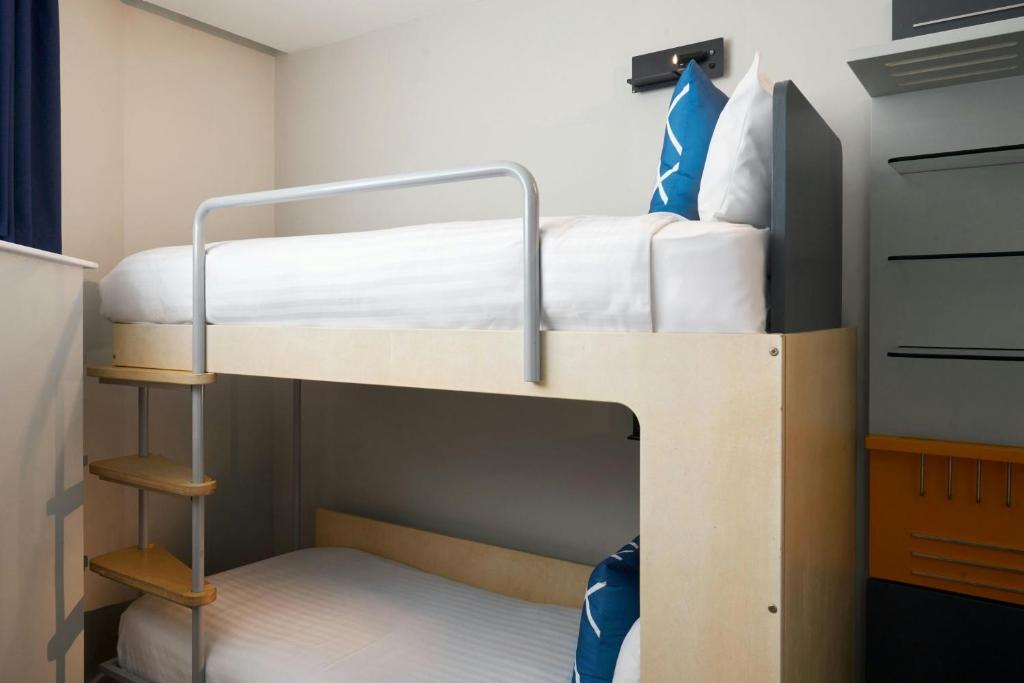
Exit the station building and turn left. Your hotel, Sleeperz Cardiff, is near the station.
The history of the castle dates back to the 50s AD. Through the Norman times, from which the Norman Tower has survived.
The castle dates back to Roman times and archaeology proves that there have been 4 different fortresses over the years.
The castle flourished in the possession of the Earls of Bute in the 18th century, who acquired it by marriage. Their son, John 3rd Marquess of Bute, then subsequently rebuilt the fortress into a castle in collaboration with the architect Burges. He was considered the most powerful man in the world at the time. The sumptuous ornamentation of the chambers, the murals and the sculptures are still preserved today.
The castle also fulfilled a defensive role during World War II. Air-raid shelters were created in the tunnels of the perimeter walls, which could hold 2,000 inhabitants.

You can walk across the city or hop on a train from Cardiff Queen Street station. It's a 1-station ride to Cardiff Bay station.
The Cardiff bay trail walk runs the length of the bay. This gives you the chance to explore all the highlights of Cardiff Bay, which was transformed into a freshwater bay at the end of the millennium.
Start right at the Welsh Millennium Centre, which is home to the Welsh Opera House, among other things. Just beyond that is Pierhead, which houses a clock called the Welsh Bigben. Further along the trail, you'll see the Church of Norway building and perhaps an installation from Dr Who.
You can return along the bay, or at its end at the roundabout at the Custom house place stop, catch bus no. 305 back to Cardiff city centre.


Departure Day
Transfer to Bristol Airport for departure home.
Cardiff - Bristol Temple Meads train
Bristol Temple Meads - Bristol Airport (bus A1 Airport flyer)
Your journey ends here. You are about to fly home.
A week of exploring the natural beauty, as well as the history and towns here, gave you an insight into what a beautiful part of South Wales it really is. It could be the initial inspiration for your exploration of the other wonders of this part of the UK.
South Wales is full of beautiful historic sites and even more beautiful coastline. You'll start your journey exploring the historic walled city of Tenby and its vast sandy beaches. You'll move on to the city of Swansea on Swansea Bay with its shell-rich beaches and the most beautiful sunsets. You will then walk along the south coast of one of the most beautiful protected areas - the Gower Peninsula.
Turn to the capital city of Cardiff to explore the city, the castle and the bay.
Today you will be travelling to Bristol, where you will make your way from the airport to your accommodation. If you have the appetite and energy, head out to explore the city.
You're best off taking a bus from Bristol Airport to the city centre. There's a direct service from Airport Terminal to Temple Meads Station, which is about a 15-minute walk to your accommodation.
>
Airport Flyer ticketing options:
Online booking via www.thetrainline.com for combined train/Airport Flyer tickets
Direct payment to the Airport Flyer driver upon boarding
Today you're going to do a little traveling. From here you will travel through South Wales to your starting destination, the town of Tenby, and then check in.
Get on the train to Cardiff Central, in England it is generally preferable to buy train tickets at least a week or two in advance, but ideally at least a month. There are trains to Tenby with a change in Cardiff.
You have a full day to explore this amazing colourful walled city. Enjoy the harbour, explore the history of the walls and the remains of the castle. At low tide, head to St Catherine's Island and enjoy the local beaches to the full.
To see the beauty and history of the walled town of Tenby
- Tenby
A seaside town in Pembrokeshire, which is one of the most colourful towns in Britain. This is Tenby. Dive into its colourful streets and explore them properly. The museum and Tudor House will give you a glimpse of local history. The town is unique for its well-preserved 13th century medieval walls, which are listed.
Explore the ruins of the local castle, which kind of watches over the whole coastline. Don't miss a walk along the beach past the lifeguard station with its boat slipway. Finally, you can visit the tidal island of St Catherine's with the 19th century Palmerston Fort at its summit.
Very few elements of the originally medieval castle from the 13th century have survived. From the harbour you can walk through the main gate towards the square. The watchtower stands atop the rocky promontory of Castle Hill. It's made up of two different towers and sort of watches over the coastline of the town. You can now visit the museum and art gallery where the great hall once stood.
Go down to the beach towards St. Catherine's Island.
At low tide, explore St Catherine's Island, just off the local beach. You can discover several caves in the rocky cliffs, which are interspersed with the cliffs. Afterwards, head to the top of the island to see the 1890 Palmerston Fort. Although it's currently abandoned, its history is varied. From a defensive fort, to a private owner's palatial residence, to a zoo.
Victorian hotel overlooking South Beach
Transfer to Swansea, sightseeing and the bay
Swansea and Oystermouth castle
Today you will be transferred by train to the city of Swansea. This is the first of three days you will spend in the area.
Explore the city and Swansea Bay.
Train Tenby - Swansea
Swansea is the second largest city in Wales. A town with a Roman and Viking history, it is now widely sought after for relaxation and recreation. This is mainly due to its location on the shores of Swansea Bay and the nearby Gower Peninsula.
In its centre you can explore the remains of the local castle. In the southern part of the city, you can explore the marina.
From the hotel, head towards the castle.
Looking at the remains of the castle today, it is hard to imagine the sprawling fortress that once stood on a rock above the Tawe River. Both the castle and the town have been transformed. Two late 14th century blocks of the castle remain, complete with signs with historical facts. The surrounding buildings have been transformed into modern ones, complete with a cascading fountain falling towards the centre of the square.
Take a walk to the marina.
Move to Swansea marina, located in the south of the city. Take a pleasant walk around the marina and you'll discover several places of interest. Be sure to visit the National Museum, which offers free admission and exhibitions focusing on the city's history, as well as, for example, an aviation exhibition. Another modern venue is the multicultural Swansea Arena, which offers concerts, standup or dance performances. Also worth a visit is the Swansea Museum or the Dean Thomas Theatre, a Swansea native. The west is dominated by the unmissable Meridian Tower.
Trace the history of Oystermout Castle. First, you'll get a beautiful view of the bay, and the nearby village of Mumbles. After that, through the castle gate you can enter into the rich history of the 12th century castle, which was largely invaded by the surrounding Welsh people. It was inhabited until the 16th century, after which it fell into disrepair. Reconstruction only came in the early 21st century and today it is mainly open to tourists.
From Oystermouth go to Clyne Gardens.
Your last stop today may be Clyne Gardens. It is a botanical garden spread over 19 hectares of land. You can see more than 2,000 plants, mostly rhododendrons. As you walk around, you may come across small buildings of several architectural styles. From Japanese to Italian. Admission is free and unrestricted.
Slug & Lettuce Swansea is a restaurant with a cocktail bar on the first floor. It is located in a historic house just a short walk from the ruins of Swansea Castle.
The menu ranges from burgers, steaks, nachos to classic fish & chips. Beers and cider on tap.
South coast of the Gower Peninsula Den 1.
Caswell bay, Langland bay, Bracelet bay, Mumbles pier & Lighthouse
Today you will have an easy trek along the coast of the Gower Peninsula, specifically the eastern part of the peninsula.
From Caswell bay you will walk along the footpath to the village of Mumbles. From the pier you can admire the local lighthouse or look out across Swansea Bay.
From the hotel, head to the bus station.
Bus 2C (gate W) to Caswell Bay stop.
Caswell Bay is one of the beautiful bays with a large sandy beach on the coast of the Gower Peninsula. The place is often popular with surfers.
Morning refreshments available. Surfside Caffé is located in the left corner at the entrance to the beach. You can sit inside or outside, takeway.
- cold and hot drinks
- ice cream
- snacks
Langland is another bay on the Gower coast. It is characterised by a row of holiday cottages in one colour across the width of the bay. The beach is more rocky.
Freshments available at the Surfside café right on the beach. Outdoor seating, takeway available.
- ice cream
- cold and hot drinks
- snacks
Short trip to Mumbles.
You are at the destination of today's trip. Explore the 255-metre-long late 19th-century Victorian pier. Because of its position at the far end, it offers spectacular panoramic views of Swansea Bay and the lighthouse.
A few metres away is a small sandy beach, reached by a flight of steps.
A local bistro offering British classics.
- fish & chips
- sausages
- curry
- beer & cider
From Mumbles Pier, run up the stairs back to Bracelet Bay. From the Bracelet Bay nr. Pier Hotel bus stop, take bus number 2 or 3 to Swansea.
South Coast of the Gower Peninsula Day 2.
Three cliffs bay - Rhosilli day trek
Today you will have a full day trek along the south coast of the Gower Peninsula. The route is approximately 26 km . You will see the best of the south coast. Huge expansive beaches will alternate seamlessly with interesting cliffs. You will end your journey at Rhosilli bay.
If the route is too long for you, you can hop on bus 118 at Port Eynon and cut your journey to Rhosilli short.
At the bus station, take bus No. 118 towards Rhosilli (gate T). Get off at the Penmean house stop. Signposts will guide you to the beach.
Three cliffs bay named after 3 limestone cliffs, about 20 m high, running out to the sea. At low tide its vastness and beauty is most apparent, so you can explore all the cliffs. It has been voted the best beach in the UK.
Climb back up to the cliff and follow the signpost that leads you along the coastal path to Oxwich Bay via Nicholaston Woods.
Another beautiful sandy beach across Oxwich bay for 4 km. It is bordered by dunes, behind which there are wetlands and a nature reserve.
Brick stand by the beach. Offers British classics.
- Cold and hot drinks
- ice cream
- burgers
- fish&chips
- beer&cider
From Oxwich Bay Hotel, rejoin the coastal path and continue towards the church. Walk along the coast to Port Eynon.
A sought-after bay with a large beach and a village of the same name. At the southern end of the bay you will find the remains of the so-called "salt house", which was used to extract salt from sea water. On the cliff above it is Port Eynon Point, the southernmost point of the Gower Peninsula.
Because you've walked enough, this pub is a great alternative to a good lunch. Very nice atmosphere and service. You can sit in the outdoor seating area. Most of the menu here is locally sourced.
- burgers
- Fish
- pizza
- local beers&cider
- cold drinks
A section with a coastline full of caves and unique cliffs awaits you.
Climb to Port Eynon Point and follow the coastal path back to Rhosilli.
A unique natural area under the auspices of the National Trust, located in the first level of protection. The area is dominated by the vast Rhosilli Bay to the north, with a dune-filled beach that is a must-explore. At the northern end is Burry Holms, which is a tidal island. Its history dates back to the Mesolithic. Beyond the beach north of the village is the highest point (Beacon 198m above sea level, full of prehistoric remains) of the whole peninsula.
At the southern end of the bay, Worms Head, which consists of the Inner and Outer Head (two outflow islands), then runs out to sea. If it is low tide and you decide to visit Worms Head, make sure you return early. Tourist rescues are quite common here.
Seaside restaurant with outdoor seating overlooking Rhosilli beach.
The high season tends to be very busy. Rhosilli is a very popular place.
The restaurant then offers British classics in the form of sandwiches and fish & chips. They have local beers&cider on tap.
Bus No. 118 from Rhosilli Terminus back to Swansea
Travel to Cardiff & explore the city
Cardiff, Cardiff castle, Cardiff bay
Today you'll be transferred to the capital of Wales. A university city whose centre is dominated by its eponymous castle, complete with the vast Bute Park. In the old town around the castle there are plenty of arcades and old Victorian streets to explore, as well as a 19th century covered market.
In the south you'll find the harbour and bay.
Swansea to Cardiff Central Train
Exit the station building and turn left. Your hotel, Sleeperz Cardiff, is near the station.
The history of the castle dates back to the 50s AD. Through the Norman times, from which the Norman Tower has survived.
The castle dates back to Roman times and archaeology proves that there have been 4 different fortresses over the years.
The castle flourished in the possession of the Earls of Bute in the 18th century, who acquired it by marriage. Their son, John 3rd Marquess of Bute, then subsequently rebuilt the fortress into a castle in collaboration with the architect Burges. He was considered the most powerful man in the world at the time. The sumptuous ornamentation of the chambers, the murals and the sculptures are still preserved today.
The castle also fulfilled a defensive role during World War II. Air-raid shelters were created in the tunnels of the perimeter walls, which could hold 2,000 inhabitants.
You can walk across the city or hop on a train from Cardiff Queen Street station. It's a 1-station ride to Cardiff Bay station.
The Cardiff bay trail walk runs the length of the bay. This gives you the chance to explore all the highlights of Cardiff Bay, which was transformed into a freshwater bay at the end of the millennium.
Start right at the Welsh Millennium Centre, which is home to the Welsh Opera House, among other things. Just beyond that is Pierhead, which houses a clock called the Welsh Bigben. Further along the trail, you'll see the Church of Norway building and perhaps an installation from Dr Who.
You can return along the bay, or at its end at the roundabout at the Custom house place stop, catch bus no. 305 back to Cardiff city centre.
Departure Day
Transfer to Bristol Airport for departure home.
Cardiff - Bristol Temple Meads train
Bristol Temple Meads - Bristol Airport (bus A1 Airport flyer)
Your journey ends here. You are about to fly home.
A week of exploring the natural beauty, as well as the history and towns here, gave you an insight into what a beautiful part of South Wales it really is. It could be the initial inspiration for your exploration of the other wonders of this part of the UK.

 We are a Czech companyWe are a Czech company




itinerary by Adam Horký
South Wales is full of beautiful historic sites and even more beautiful coastline. You'll start your journey exploring the historic walled city of Tenby and its vast sandy beaches. You'll move on to the city of Swansea on Swansea Bay with its shell-rich beaches and the most beautiful sunsets. You will then walk along the south coast of one of the most beautiful protected areas - the Gower Peninsula.
Turn to the capital city of Cardiff to explore the city, the castle and the bay.
Today you will be travelling to Bristol, where you will make your way from the airport to your accommodation. If you have the appetite and energy, head out to explore the city.
You're best off taking a bus from Bristol Airport to the city centre. There's a direct service from Airport Terminal to Temple Meads Station, which is about a 15-minute walk to your accommodation.
>
Airport Flyer ticketing options:
Online booking via www.thetrainline.com for combined train/Airport Flyer tickets
Direct payment to the Airport Flyer driver upon boarding
Today you're going to do a little traveling. From here you will travel through South Wales to your starting destination, the town of Tenby, and then check in.
Get on the train to Cardiff Central, in England it is generally preferable to buy train tickets at least a week or two in advance, but ideally at least a month. There are trains to Tenby with a change in Cardiff.
You have a full day to explore this amazing colourful walled city. Enjoy the harbour, explore the history of the walls and the remains of the castle. At low tide, head to St Catherine's Island and enjoy the local beaches to the full.
To see the beauty and history of the walled town of Tenby
- Tenby
A seaside town in Pembrokeshire, which is one of the most colourful towns in Britain. This is Tenby. Dive into its colourful streets and explore them properly. The museum and Tudor House will give you a glimpse of local history. The town is unique for its well-preserved 13th century medieval walls, which are listed.
Explore the ruins of the local castle, which kind of watches over the whole coastline. Don't miss a walk along the beach past the lifeguard station with its boat slipway. Finally, you can visit the tidal island of St Catherine's with the 19th century Palmerston Fort at its summit.
Very few elements of the originally medieval castle from the 13th century have survived. From the harbour you can walk through the main gate towards the square. The watchtower stands atop the rocky promontory of Castle Hill. It's made up of two different towers and sort of watches over the coastline of the town. You can now visit the museum and art gallery where the great hall once stood.
Go down to the beach towards St. Catherine's Island.
At low tide, explore St Catherine's Island, just off the local beach. You can discover several caves in the rocky cliffs, which are interspersed with the cliffs. Afterwards, head to the top of the island to see the 1890 Palmerston Fort. Although it's currently abandoned, its history is varied. From a defensive fort, to a private owner's palatial residence, to a zoo.
Victorian hotel overlooking South Beach
Transfer to Swansea, sightseeing and the bay
Swansea and Oystermouth castle
Today you will be transferred by train to the city of Swansea. This is the first of three days you will spend in the area.
Explore the city and Swansea Bay.
Train Tenby - Swansea
Swansea is the second largest city in Wales. A town with a Roman and Viking history, it is now widely sought after for relaxation and recreation. This is mainly due to its location on the shores of Swansea Bay and the nearby Gower Peninsula.
In its centre you can explore the remains of the local castle. In the southern part of the city, you can explore the marina.
From the hotel, head towards the castle.
Looking at the remains of the castle today, it is hard to imagine the sprawling fortress that once stood on a rock above the Tawe River. Both the castle and the town have been transformed. Two late 14th century blocks of the castle remain, complete with signs with historical facts. The surrounding buildings have been transformed into modern ones, complete with a cascading fountain falling towards the centre of the square.
Take a walk to the marina.
Move to Swansea marina, located in the south of the city. Take a pleasant walk around the marina and you'll discover several places of interest. Be sure to visit the National Museum, which offers free admission and exhibitions focusing on the city's history, as well as, for example, an aviation exhibition. Another modern venue is the multicultural Swansea Arena, which offers concerts, standup or dance performances. Also worth a visit is the Swansea Museum or the Dean Thomas Theatre, a Swansea native. The west is dominated by the unmissable Meridian Tower.
Trace the history of Oystermout Castle. First, you'll get a beautiful view of the bay, and the nearby village of Mumbles. After that, through the castle gate you can enter into the rich history of the 12th century castle, which was largely invaded by the surrounding Welsh people. It was inhabited until the 16th century, after which it fell into disrepair. Reconstruction only came in the early 21st century and today it is mainly open to tourists.
From Oystermouth go to Clyne Gardens.
Your last stop today may be Clyne Gardens. It is a botanical garden spread over 19 hectares of land. You can see more than 2,000 plants, mostly rhododendrons. As you walk around, you may come across small buildings of several architectural styles. From Japanese to Italian. Admission is free and unrestricted.
Slug & Lettuce Swansea is a restaurant with a cocktail bar on the first floor. It is located in a historic house just a short walk from the ruins of Swansea Castle.
The menu ranges from burgers, steaks, nachos to classic fish & chips. Beers and cider on tap.
South coast of the Gower Peninsula Den 1.
Caswell bay, Langland bay, Bracelet bay, Mumbles pier & Lighthouse
Today you will have an easy trek along the coast of the Gower Peninsula, specifically the eastern part of the peninsula.
From Caswell bay you will walk along the footpath to the village of Mumbles. From the pier you can admire the local lighthouse or look out across Swansea Bay.
From the hotel, head to the bus station.
Bus 2C (gate W) to Caswell Bay stop.
Caswell Bay is one of the beautiful bays with a large sandy beach on the coast of the Gower Peninsula. The place is often popular with surfers.
Morning refreshments available. Surfside Caffé is located in the left corner at the entrance to the beach. You can sit inside or outside, takeway.
- cold and hot drinks
- ice cream
- snacks
Langland is another bay on the Gower coast. It is characterised by a row of holiday cottages in one colour across the width of the bay. The beach is more rocky.
Freshments available at the Surfside café right on the beach. Outdoor seating, takeway available.
- ice cream
- cold and hot drinks
- snacks
Short trip to Mumbles.
You are at the destination of today's trip. Explore the 255-metre-long late 19th-century Victorian pier. Because of its position at the far end, it offers spectacular panoramic views of Swansea Bay and the lighthouse.
A few metres away is a small sandy beach, reached by a flight of steps.
A local bistro offering British classics.
- fish & chips
- sausages
- curry
- beer & cider
From Mumbles Pier, run up the stairs back to Bracelet Bay. From the Bracelet Bay nr. Pier Hotel bus stop, take bus number 2 or 3 to Swansea.
South Coast of the Gower Peninsula Day 2.
Three cliffs bay - Rhosilli day trek
Today you will have a full day trek along the south coast of the Gower Peninsula. The route is approximately 26 km . You will see the best of the south coast. Huge expansive beaches will alternate seamlessly with interesting cliffs. You will end your journey at Rhosilli bay.
If the route is too long for you, you can hop on bus 118 at Port Eynon and cut your journey to Rhosilli short.
At the bus station, take bus No. 118 towards Rhosilli (gate T). Get off at the Penmean house stop. Signposts will guide you to the beach.
Three cliffs bay named after 3 limestone cliffs, about 20 m high, running out to the sea. At low tide its vastness and beauty is most apparent, so you can explore all the cliffs. It has been voted the best beach in the UK.
Climb back up to the cliff and follow the signpost that leads you along the coastal path to Oxwich Bay via Nicholaston Woods.
Another beautiful sandy beach across Oxwich bay for 4 km. It is bordered by dunes, behind which there are wetlands and a nature reserve.
Brick stand by the beach. Offers British classics.
- Cold and hot drinks
- ice cream
- burgers
- fish&chips
- beer&cider
From Oxwich Bay Hotel, rejoin the coastal path and continue towards the church. Walk along the coast to Port Eynon.
A sought-after bay with a large beach and a village of the same name. At the southern end of the bay you will find the remains of the so-called "salt house", which was used to extract salt from sea water. On the cliff above it is Port Eynon Point, the southernmost point of the Gower Peninsula.
Because you've walked enough, this pub is a great alternative to a good lunch. Very nice atmosphere and service. You can sit in the outdoor seating area. Most of the menu here is locally sourced.
- burgers
- Fish
- pizza
- local beers&cider
- cold drinks
A section with a coastline full of caves and unique cliffs awaits you.
Climb to Port Eynon Point and follow the coastal path back to Rhosilli.
A unique natural area under the auspices of the National Trust, located in the first level of protection. The area is dominated by the vast Rhosilli Bay to the north, with a dune-filled beach that is a must-explore. At the northern end is Burry Holms, which is a tidal island. Its history dates back to the Mesolithic. Beyond the beach north of the village is the highest point (Beacon 198m above sea level, full of prehistoric remains) of the whole peninsula.
At the southern end of the bay, Worms Head, which consists of the Inner and Outer Head (two outflow islands), then runs out to sea. If it is low tide and you decide to visit Worms Head, make sure you return early. Tourist rescues are quite common here.
Seaside restaurant with outdoor seating overlooking Rhosilli beach.
The high season tends to be very busy. Rhosilli is a very popular place.
The restaurant then offers British classics in the form of sandwiches and fish & chips. They have local beers&cider on tap.
Bus No. 118 from Rhosilli Terminus back to Swansea
Travel to Cardiff & explore the city
Cardiff, Cardiff castle, Cardiff bay
Today you'll be transferred to the capital of Wales. A university city whose centre is dominated by its eponymous castle, complete with the vast Bute Park. In the old town around the castle there are plenty of arcades and old Victorian streets to explore, as well as a 19th century covered market.
In the south you'll find the harbour and bay.
Swansea to Cardiff Central Train
Exit the station building and turn left. Your hotel, Sleeperz Cardiff, is near the station.
The history of the castle dates back to the 50s AD. Through the Norman times, from which the Norman Tower has survived.
The castle dates back to Roman times and archaeology proves that there have been 4 different fortresses over the years.
The castle flourished in the possession of the Earls of Bute in the 18th century, who acquired it by marriage. Their son, John 3rd Marquess of Bute, then subsequently rebuilt the fortress into a castle in collaboration with the architect Burges. He was considered the most powerful man in the world at the time. The sumptuous ornamentation of the chambers, the murals and the sculptures are still preserved today.
The castle also fulfilled a defensive role during World War II. Air-raid shelters were created in the tunnels of the perimeter walls, which could hold 2,000 inhabitants.
You can walk across the city or hop on a train from Cardiff Queen Street station. It's a 1-station ride to Cardiff Bay station.
The Cardiff bay trail walk runs the length of the bay. This gives you the chance to explore all the highlights of Cardiff Bay, which was transformed into a freshwater bay at the end of the millennium.
Start right at the Welsh Millennium Centre, which is home to the Welsh Opera House, among other things. Just beyond that is Pierhead, which houses a clock called the Welsh Bigben. Further along the trail, you'll see the Church of Norway building and perhaps an installation from Dr Who.
You can return along the bay, or at its end at the roundabout at the Custom house place stop, catch bus no. 305 back to Cardiff city centre.
Departure Day
Transfer to Bristol Airport for departure home.
Cardiff - Bristol Temple Meads train
Bristol Temple Meads - Bristol Airport (bus A1 Airport flyer)
Your journey ends here. You are about to fly home.
A week of exploring the natural beauty, as well as the history and towns here, gave you an insight into what a beautiful part of South Wales it really is. It could be the initial inspiration for your exploration of the other wonders of this part of the UK.
South Wales is full of beautiful historic sites and even more beautiful coastline. You'll start your journey exploring the historic walled city of Tenby and its vast sandy beaches. You'll move on to the city of Swansea on Swansea Bay with its shell-rich beaches and the most beautiful sunsets. You will then walk along the south coast of one of the most beautiful protected areas - the Gower Peninsula.
Turn to the capital city of Cardiff to explore the city, the castle and the bay.
Today you will be travelling to Bristol, where you will make your way from the airport to your accommodation. If you have the appetite and energy, head out to explore the city.
You're best off taking a bus from Bristol Airport to the city centre. There's a direct service from Airport Terminal to Temple Meads Station, which is about a 15-minute walk to your accommodation.
>
Airport Flyer ticketing options:
Online booking via www.thetrainline.com for combined train/Airport Flyer tickets
Direct payment to the Airport Flyer driver upon boarding
Today you're going to do a little traveling. From here you will travel through South Wales to your starting destination, the town of Tenby, and then check in.
Get on the train to Cardiff Central, in England it is generally preferable to buy train tickets at least a week or two in advance, but ideally at least a month. There are trains to Tenby with a change in Cardiff.
You have a full day to explore this amazing colourful walled city. Enjoy the harbour, explore the history of the walls and the remains of the castle. At low tide, head to St Catherine's Island and enjoy the local beaches to the full.
To see the beauty and history of the walled town of Tenby
- Tenby
A seaside town in Pembrokeshire, which is one of the most colourful towns in Britain. This is Tenby. Dive into its colourful streets and explore them properly. The museum and Tudor House will give you a glimpse of local history. The town is unique for its well-preserved 13th century medieval walls, which are listed.
Explore the ruins of the local castle, which kind of watches over the whole coastline. Don't miss a walk along the beach past the lifeguard station with its boat slipway. Finally, you can visit the tidal island of St Catherine's with the 19th century Palmerston Fort at its summit.
Very few elements of the originally medieval castle from the 13th century have survived. From the harbour you can walk through the main gate towards the square. The watchtower stands atop the rocky promontory of Castle Hill. It's made up of two different towers and sort of watches over the coastline of the town. You can now visit the museum and art gallery where the great hall once stood.
Go down to the beach towards St. Catherine's Island.
At low tide, explore St Catherine's Island, just off the local beach. You can discover several caves in the rocky cliffs, which are interspersed with the cliffs. Afterwards, head to the top of the island to see the 1890 Palmerston Fort. Although it's currently abandoned, its history is varied. From a defensive fort, to a private owner's palatial residence, to a zoo.
Victorian hotel overlooking South Beach
Transfer to Swansea, sightseeing and the bay
Swansea and Oystermouth castle
Today you will be transferred by train to the city of Swansea. This is the first of three days you will spend in the area.
Explore the city and Swansea Bay.
Train Tenby - Swansea
Swansea is the second largest city in Wales. A town with a Roman and Viking history, it is now widely sought after for relaxation and recreation. This is mainly due to its location on the shores of Swansea Bay and the nearby Gower Peninsula.
In its centre you can explore the remains of the local castle. In the southern part of the city, you can explore the marina.
From the hotel, head towards the castle.
Looking at the remains of the castle today, it is hard to imagine the sprawling fortress that once stood on a rock above the Tawe River. Both the castle and the town have been transformed. Two late 14th century blocks of the castle remain, complete with signs with historical facts. The surrounding buildings have been transformed into modern ones, complete with a cascading fountain falling towards the centre of the square.
Take a walk to the marina.
Move to Swansea marina, located in the south of the city. Take a pleasant walk around the marina and you'll discover several places of interest. Be sure to visit the National Museum, which offers free admission and exhibitions focusing on the city's history, as well as, for example, an aviation exhibition. Another modern venue is the multicultural Swansea Arena, which offers concerts, standup or dance performances. Also worth a visit is the Swansea Museum or the Dean Thomas Theatre, a Swansea native. The west is dominated by the unmissable Meridian Tower.
Trace the history of Oystermout Castle. First, you'll get a beautiful view of the bay, and the nearby village of Mumbles. After that, through the castle gate you can enter into the rich history of the 12th century castle, which was largely invaded by the surrounding Welsh people. It was inhabited until the 16th century, after which it fell into disrepair. Reconstruction only came in the early 21st century and today it is mainly open to tourists.
From Oystermouth go to Clyne Gardens.
Your last stop today may be Clyne Gardens. It is a botanical garden spread over 19 hectares of land. You can see more than 2,000 plants, mostly rhododendrons. As you walk around, you may come across small buildings of several architectural styles. From Japanese to Italian. Admission is free and unrestricted.
Slug & Lettuce Swansea is a restaurant with a cocktail bar on the first floor. It is located in a historic house just a short walk from the ruins of Swansea Castle.
The menu ranges from burgers, steaks, nachos to classic fish & chips. Beers and cider on tap.
South coast of the Gower Peninsula Den 1.
Caswell bay, Langland bay, Bracelet bay, Mumbles pier & Lighthouse
Today you will have an easy trek along the coast of the Gower Peninsula, specifically the eastern part of the peninsula.
From Caswell bay you will walk along the footpath to the village of Mumbles. From the pier you can admire the local lighthouse or look out across Swansea Bay.
From the hotel, head to the bus station.
Bus 2C (gate W) to Caswell Bay stop.
Caswell Bay is one of the beautiful bays with a large sandy beach on the coast of the Gower Peninsula. The place is often popular with surfers.
Morning refreshments available. Surfside Caffé is located in the left corner at the entrance to the beach. You can sit inside or outside, takeway.
- cold and hot drinks
- ice cream
- snacks
Langland is another bay on the Gower coast. It is characterised by a row of holiday cottages in one colour across the width of the bay. The beach is more rocky.
Freshments available at the Surfside café right on the beach. Outdoor seating, takeway available.
- ice cream
- cold and hot drinks
- snacks
Short trip to Mumbles.
You are at the destination of today's trip. Explore the 255-metre-long late 19th-century Victorian pier. Because of its position at the far end, it offers spectacular panoramic views of Swansea Bay and the lighthouse.
A few metres away is a small sandy beach, reached by a flight of steps.
A local bistro offering British classics.
- fish & chips
- sausages
- curry
- beer & cider
From Mumbles Pier, run up the stairs back to Bracelet Bay. From the Bracelet Bay nr. Pier Hotel bus stop, take bus number 2 or 3 to Swansea.
South Coast of the Gower Peninsula Day 2.
Three cliffs bay - Rhosilli day trek
Today you will have a full day trek along the south coast of the Gower Peninsula. The route is approximately 26 km . You will see the best of the south coast. Huge expansive beaches will alternate seamlessly with interesting cliffs. You will end your journey at Rhosilli bay.
If the route is too long for you, you can hop on bus 118 at Port Eynon and cut your journey to Rhosilli short.
At the bus station, take bus No. 118 towards Rhosilli (gate T). Get off at the Penmean house stop. Signposts will guide you to the beach.
Three cliffs bay named after 3 limestone cliffs, about 20 m high, running out to the sea. At low tide its vastness and beauty is most apparent, so you can explore all the cliffs. It has been voted the best beach in the UK.
Climb back up to the cliff and follow the signpost that leads you along the coastal path to Oxwich Bay via Nicholaston Woods.
Another beautiful sandy beach across Oxwich bay for 4 km. It is bordered by dunes, behind which there are wetlands and a nature reserve.
Brick stand by the beach. Offers British classics.
- Cold and hot drinks
- ice cream
- burgers
- fish&chips
- beer&cider
From Oxwich Bay Hotel, rejoin the coastal path and continue towards the church. Walk along the coast to Port Eynon.
A sought-after bay with a large beach and a village of the same name. At the southern end of the bay you will find the remains of the so-called "salt house", which was used to extract salt from sea water. On the cliff above it is Port Eynon Point, the southernmost point of the Gower Peninsula.
Because you've walked enough, this pub is a great alternative to a good lunch. Very nice atmosphere and service. You can sit in the outdoor seating area. Most of the menu here is locally sourced.
- burgers
- Fish
- pizza
- local beers&cider
- cold drinks
A section with a coastline full of caves and unique cliffs awaits you.
Climb to Port Eynon Point and follow the coastal path back to Rhosilli.
A unique natural area under the auspices of the National Trust, located in the first level of protection. The area is dominated by the vast Rhosilli Bay to the north, with a dune-filled beach that is a must-explore. At the northern end is Burry Holms, which is a tidal island. Its history dates back to the Mesolithic. Beyond the beach north of the village is the highest point (Beacon 198m above sea level, full of prehistoric remains) of the whole peninsula.
At the southern end of the bay, Worms Head, which consists of the Inner and Outer Head (two outflow islands), then runs out to sea. If it is low tide and you decide to visit Worms Head, make sure you return early. Tourist rescues are quite common here.
Seaside restaurant with outdoor seating overlooking Rhosilli beach.
The high season tends to be very busy. Rhosilli is a very popular place.
The restaurant then offers British classics in the form of sandwiches and fish & chips. They have local beers&cider on tap.
Bus No. 118 from Rhosilli Terminus back to Swansea
Travel to Cardiff & explore the city
Cardiff, Cardiff castle, Cardiff bay
Today you'll be transferred to the capital of Wales. A university city whose centre is dominated by its eponymous castle, complete with the vast Bute Park. In the old town around the castle there are plenty of arcades and old Victorian streets to explore, as well as a 19th century covered market.
In the south you'll find the harbour and bay.
Swansea to Cardiff Central Train
Exit the station building and turn left. Your hotel, Sleeperz Cardiff, is near the station.
The history of the castle dates back to the 50s AD. Through the Norman times, from which the Norman Tower has survived.
The castle dates back to Roman times and archaeology proves that there have been 4 different fortresses over the years.
The castle flourished in the possession of the Earls of Bute in the 18th century, who acquired it by marriage. Their son, John 3rd Marquess of Bute, then subsequently rebuilt the fortress into a castle in collaboration with the architect Burges. He was considered the most powerful man in the world at the time. The sumptuous ornamentation of the chambers, the murals and the sculptures are still preserved today.
The castle also fulfilled a defensive role during World War II. Air-raid shelters were created in the tunnels of the perimeter walls, which could hold 2,000 inhabitants.
You can walk across the city or hop on a train from Cardiff Queen Street station. It's a 1-station ride to Cardiff Bay station.
The Cardiff bay trail walk runs the length of the bay. This gives you the chance to explore all the highlights of Cardiff Bay, which was transformed into a freshwater bay at the end of the millennium.
Start right at the Welsh Millennium Centre, which is home to the Welsh Opera House, among other things. Just beyond that is Pierhead, which houses a clock called the Welsh Bigben. Further along the trail, you'll see the Church of Norway building and perhaps an installation from Dr Who.
You can return along the bay, or at its end at the roundabout at the Custom house place stop, catch bus no. 305 back to Cardiff city centre.
Departure Day
Transfer to Bristol Airport for departure home.
Cardiff - Bristol Temple Meads train
Bristol Temple Meads - Bristol Airport (bus A1 Airport flyer)
Your journey ends here. You are about to fly home.
A week of exploring the natural beauty, as well as the history and towns here, gave you an insight into what a beautiful part of South Wales it really is. It could be the initial inspiration for your exploration of the other wonders of this part of the UK.