Discover a country where you can experience desert, a vibrant city, and unique natural scenery all within a few days. A journey through a landscape awaits you, one that seems harsh at first glance but possesses its own quiet charm. You'll get to know the atmosphere of an oriental metropolis full of contrasts, where tradition blends with modern life. You'll experience the tranquility of endless sands and the simple beauty of open space. Treat yourself to an extraordinary experience at the Dead Sea, where you can simply relax and let your worries float away. You'll walk through places that hide traces of ancient history carved in stone. This journey is about experiences that you will truly enjoy. Each day will offer something different – a different landscape, a different atmosphere, a different view of the world. Jordan will surprise you with its diversity and hospitality. Just pack your suitcase and set off.
Important information:
Jordan Pass - don't forget to arrange your visa before traveling, the Jordan Pass also includes entry to some monuments
Desert trip - the easiest option is to arrange a trip to the desert directly at your accommodation - you won't have to travel anywhere; another option is to book a trip in advance - we did this and were also very satisfied, we just paid a transfer fee at the accommodation, which we apparently wouldn't have paid if we had bought the trip from them
Money and payment - we could pay by card in some places, but many payments were also in cash; it is ideal to bring euros/dollars with you and exchange them on the spot as needed
Upon arrival, pick up your car (according to the instructions you will receive before departure) and after settling in, head out for a gentle first acquaintance with the city. In the evening, a walk through a popular neighborhood full of cafes, shops, and local atmosphere awaits you, where you can best soak up the rhythm of everyday life. You can have something good to eat, sit down for a coffee, and just watch the hustle and bustle around you. It's an ideal start to the trip - at a relaxed pace and without rushing.

While strolling down Rainbow Street, you'll come across plenty of rooftop bars, fun establishments, shops, and restaurants. You can wander around, explore the shops, and taste some great Jordanian cuisine. The street also boasts beautiful historical architecture as well as modern Jordanian culture.


The next day, you'll immerse yourself in the history and present day of the Jordanian capital. You will visit a prominent mosque with a blue dome, which is one of the symbols of the city, and then walk to an elevated spot with beautiful views and remnants of ancient civilizations. Alternatively, you can also visit the ancient theater, which recalls the Roman past of the city. In the afternoon, you will travel to the desert, where the landscape gradually transforms into open space and tranquility. In the evening, you will be greeted by a completely different atmosphere and you will feel like you are far away from the ordinary world.
The entrance for tourists is from the main road - you enter the visitor center, which is also a souvenir shop. You don't need to get a ticket in advance, you can buy it on the spot (2 JOD). A very nice lady took care of us here, who offered us tea after the tour and lent me, as a woman, a black cloak to cover myself. The view of the Orthodox church across the street is also very interesting.
King Abdullah I Mosque was built between 1982 and 1989 and is decorated with a blue mosaic dome, under which 3,000 Muslims can pray. It is the only mosque in Amman that openly welcomes non-Muslim visitors. Tourists are allowed to enter, but men must wear long trousers and women must cover their heads, arms and legs.

Don't buy a ticket, you have a Jordan Pass, which they will scan at the entrance. Inside, you can move freely and take pictures of everything at your leisure.
The Citadel is located right in the center of Amman and is one of the most important monuments you will find in the Jordanian capital. This ancient L-shaped hill, inhabited since at least the Neolithic period, is one of the original 7 hills of the city and is considered one of the oldest continuously inhabited places in the world. The Citadel is a vast archaeological site, and history-loving visitors will be thrilled to find plenty to explore here. In the middle you will find the Archaeological Museum. The most notable of the ancient ruins are the Roman Temple of Hercules, the Umayyad Palace, and the Byzantine Church.
A view from the Citadel was enough for us, but if you would like to see the monument up close, you can drive here. Parking should be possible on the adjacent street.
The Roman theatre was originally built sometime in the 2nd century AD and was restored in 1957. None of the materials used during the restoration were original, but visitors can still fully enjoy the scale of this site. The theatre still serves as a cultural venue and hosts various musical events.


Today, you'll spend the day in the desert landscape, where a trip awaits you and plenty of time to enjoy its open space and tranquility. You will enjoy the unique atmosphere of this place in the morning and part of the afternoon before heading to your next destination. Later in the afternoon, you will arrive in Wadi Musa, where you will check in and prepare for the next program. In the evening, you can enjoy an easy walk around the city and soak up its authentic atmosphere.
Important information:
The easiest option is to arrange a trip to the desert directly at the accommodation. Another option is to book a trip in advance. We did that and were very satisfied, we just paid a transfer fee at the accommodation, which we supposedly wouldn't pay if we bought the trip with them.
The easiest option is to arrange a desert trip directly at your accommodation - you won't have to travel anywhere. Another option is to book a trip in advance. That's what we did and we were also very satisfied, we just paid a transfer fee at the accommodation, which we supposedly wouldn't pay if we bought the trip from them.
Wadi Rum is a desolate rocky valley in southern Jordan. It has been inscribed on the UNESCO World Heritage List. Most of it consists of rocky and sandy desert, the remaining area is covered by semi-desert. There are many petroglyphs and inscriptions from various periods on the rocks. These rock carvings and inscriptions, along with other archaeological finds, are evidence that this area has been inhabited for up to 12,000 years.
In the evening, make time for a walk around the city. When Muslims are called to evening prayer, the atmosphere is indescribable. Towards the roundabout and in the immediate vicinity are restaurants and shops.

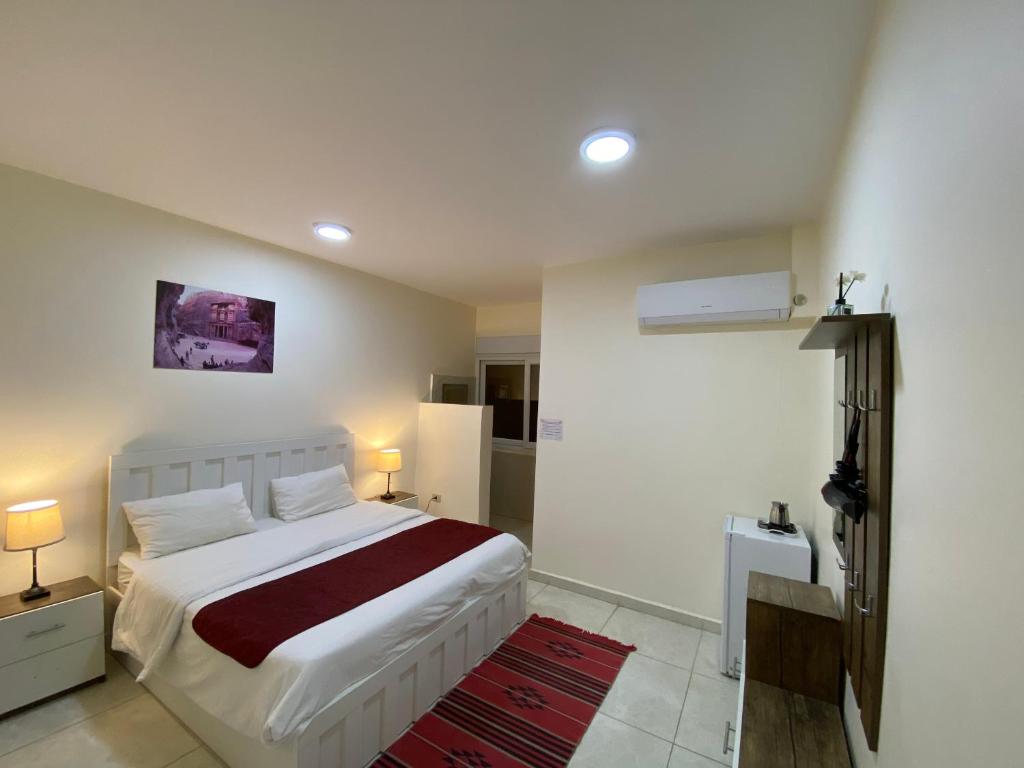
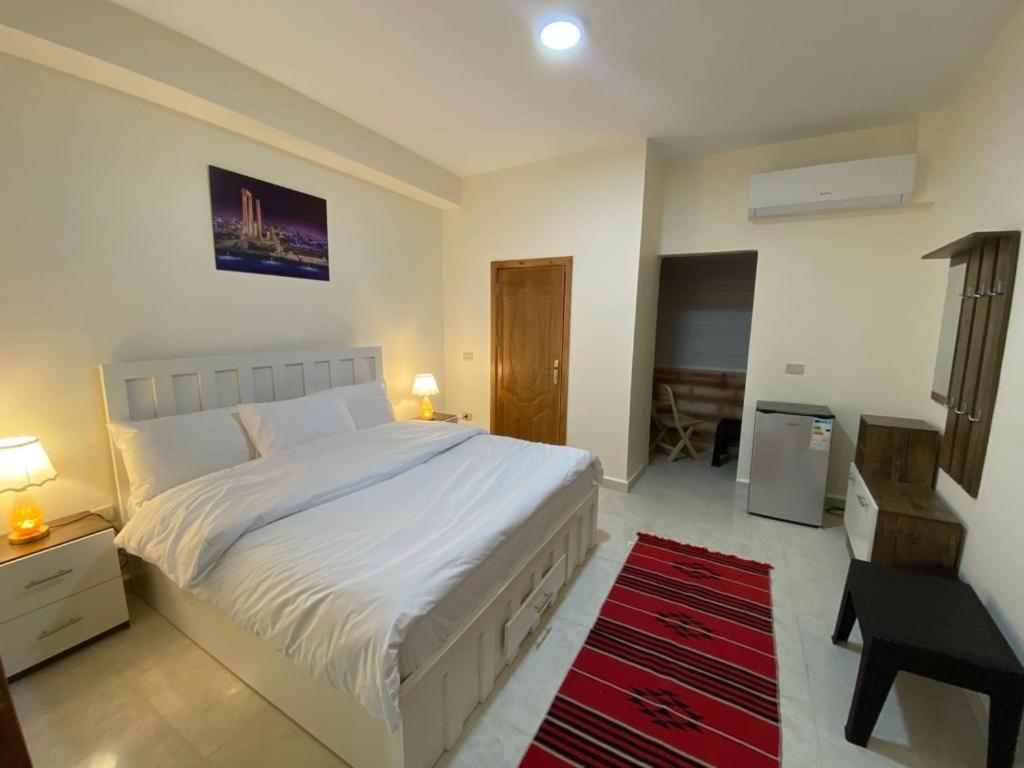
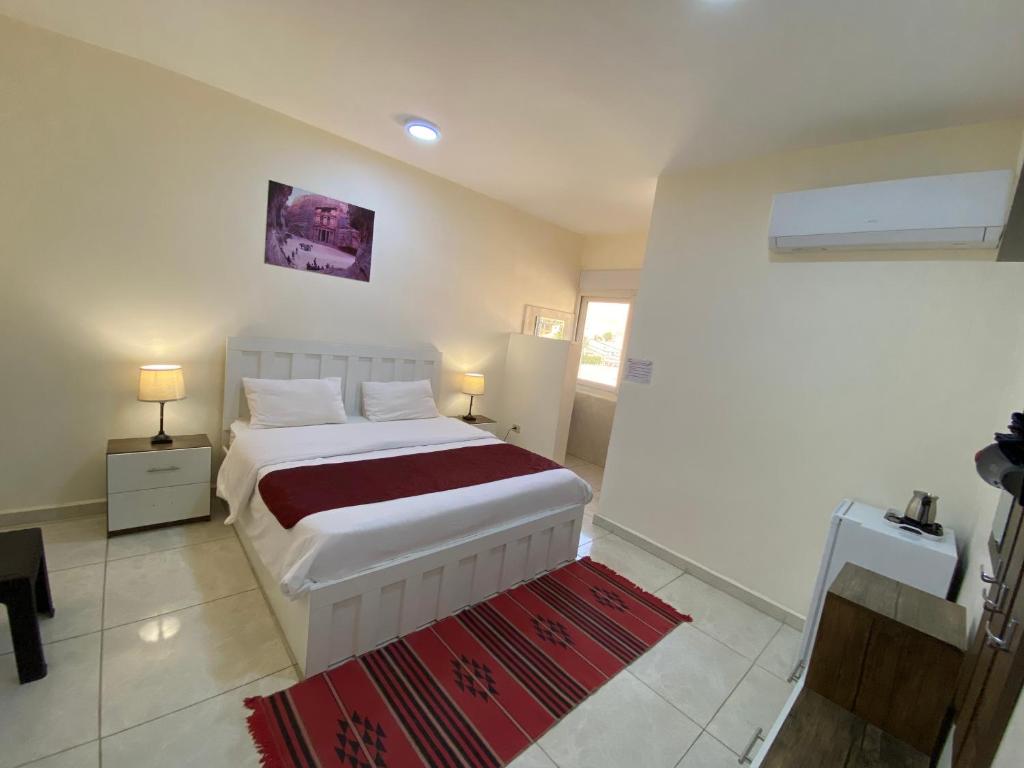
Today will be one of the main highlights of the entire trip. You will spend the whole day exploring a vast rock city, where natural scenery blends seamlessly with ancient history. You will walk the main route and beautiful nooks, and you will have enough time to see everything in peace. In the evening, you will return with the feeling that you have experienced something truly exceptional.
You have already purchased your ticket (Jordan Pass), and now it's up to you how you enjoy Petra. You have two options - choose one of them, both are great, and in both cases, you will see the most important place - the Treasury.
Donkeys/mules, horses, or shuttle carts are available along the entire route if you get tired. You can also buy refreshments and souvenirs everywhere.
1) Longer one-way route (about 15 km) - you will also see Little Petra
After parking at the visitor center, take a taxi to the side entrance. Here, your Jordan Pass will be scanned, and you will receive a printed ticket. Buy a ticket for the shuttle bus (5 JOD per person) and get dropped off at Little Petra (keep the ticket with you). You only need about 40 minutes for the tour here. Then wait for the next shuttle bus to arrive and take you to Petra from the other side. After getting dropped off, go uphill to the right, where there is a path that will take you to the Monastery (15 on the map). It is the first structure in the entire complex, and there are more people and some facilities. Then, follow the main route gradually to the main entrance where you parked in the morning.
Of course, we were most thrilled by the Treasury (14 on the map), which is about 1 to 2 km from the main entrance. The entire route took us about 7 hours because we stopped a lot for taking pictures, resting, and snacking. We liked it a lot because we would definitely not have been able to walk that far from the visitor center.
2) Shorter flexible route - you go there and back the same way, and it's up to you how far you go
After parking at the visitor center, enter Petra directly through the main entrance, and you can go as far as you want. The Treasury (14 on the map) is absolutely essential, which you will reach after about 1 to 2 km. I recommend going at least to Qasr al-Bint (13 on the map), beyond that, it's a lot of stairs.
Petra - a rock city and archaeological site in Jordan, is a UNESCO World Heritage Site. The city originally originated as a burial ground. It was probably founded between the 3rd century BC and the 1st century AD. At this time, the Nabataeans lived here, and Petra became the capital of their kingdom. All the buildings were carved into sandstone. The city reached its greatest prosperity and importance around 62 BC, when about thirty thousand people lived here. The last inhabitants left Petra after the second devastating earthquake in the 6th century. The place gradually fell into oblivion and became a secret of the local Bedouins, who carefully hid the existence of the rock city from the world. The first European (since the Crusades) to see the Royal Tomb in Petra was the Swiss researcher and traveler Johann Ludwig Burckhardt in 1812, who traveled from Syria to Egypt disguised as an Arab.

You will embark on a journey with several interesting stops. You will take a break at an unusually colored lake, which will surprise you with its color and the surrounding landscape. Then you will head to the Dead Sea, where accommodation in a hotel awaits you. In the afternoon, you can enjoy swimming and experience the unique feeling of lightness on the water.
This unique spot is on the way to your next accommodation and is easily accessible from the road. Just be careful if it has been raining, it was quite slippery for us going down the hill. First, go to the lake and then take a look at the Dead Sea - it's a perfect place for photos.
The characteristic color of the lake is due to microorganisms, especially Dunaliella salina, which is a type of algae. These thrive in the lake due to the high concentration of salt, which resembles the environment of the Dead Sea. Dunaliella salina produces a pigment known as beta-carotene, which gives the water a red-pink hue. This pigment also gives the lake a rich and vibrant appearance, especially during the warm summer months when the algae bloom abundantly. The color ranges from dark pink to light lavender, depending on the time of day and seasonal conditions.
The Dead Sea is an endorheic salt lake located between Palestine and Israel to the west and Jordan to the east. It is located 430 meters below sea level and is the lowest exposed place on the Earth's surface and the lowest salt lake in the world.
Once you check into your hotel, go down to the sea and take a swim - it's a truly unique experience.


On the last day, you can briefly soak up the atmosphere of the city (if you have time before departure) by visiting local markets - you can choose either the gold market or the decorative items market. Then you will head to the airport where you will return the rental car. This is followed by a flight home, full of new experiences from Jordan.
The Gold Souk in Amman is a paradise for those looking for unique and affordable gold and silver pieces. This traditional market offers a wide selection with fair prices and good hospitality. You can expect cheaper deals compared to other places, making it an ideal destination if you love shopping and are looking for quality goods at reasonable prices.
Souk Al Bukhari used to be a trading place right behind the Al-Hussein Mosque, but later it moved to a nearby location where it is still located today. It started as a meeting of several members of the Uzbek Bukhara community who met to sell and trade, and has since grown to 21 stores. In this market you can find traditional clothes, works of art, decorations and all kinds of colorful trinkets.
Discover a country where you can experience desert, a vibrant city, and unique natural scenery all within a few days. A journey through a landscape awaits you, one that seems harsh at first glance but possesses its own quiet charm. You'll get to know the atmosphere of an oriental metropolis full of contrasts, where tradition blends with modern life. You'll experience the tranquility of endless sands and the simple beauty of open space. Treat yourself to an extraordinary experience at the Dead Sea, where you can simply relax and let your worries float away. You'll walk through places that hide traces of ancient history carved in stone. This journey is about experiences that you will truly enjoy. Each day will offer something different – a different landscape, a different atmosphere, a different view of the world. Jordan will surprise you with its diversity and hospitality. Just pack your suitcase and set off.
Important information:
Jordan Pass - don't forget to arrange your visa before traveling, the Jordan Pass also includes entry to some monuments
Desert trip - the easiest option is to arrange a trip to the desert directly at your accommodation - you won't have to travel anywhere; another option is to book a trip in advance - we did this and were also very satisfied, we just paid a transfer fee at the accommodation, which we apparently wouldn't have paid if we had bought the trip from them
Money and payment - we could pay by card in some places, but many payments were also in cash; it is ideal to bring euros/dollars with you and exchange them on the spot as needed
Upon arrival, pick up your car (according to the instructions you will receive before departure) and after settling in, head out for a gentle first acquaintance with the city. In the evening, a walk through a popular neighborhood full of cafes, shops, and local atmosphere awaits you, where you can best soak up the rhythm of everyday life. You can have something good to eat, sit down for a coffee, and just watch the hustle and bustle around you. It's an ideal start to the trip - at a relaxed pace and without rushing.
While strolling down Rainbow Street, you'll come across plenty of rooftop bars, fun establishments, shops, and restaurants. You can wander around, explore the shops, and taste some great Jordanian cuisine. The street also boasts beautiful historical architecture as well as modern Jordanian culture.
The next day, you'll immerse yourself in the history and present day of the Jordanian capital. You will visit a prominent mosque with a blue dome, which is one of the symbols of the city, and then walk to an elevated spot with beautiful views and remnants of ancient civilizations. Alternatively, you can also visit the ancient theater, which recalls the Roman past of the city. In the afternoon, you will travel to the desert, where the landscape gradually transforms into open space and tranquility. In the evening, you will be greeted by a completely different atmosphere and you will feel like you are far away from the ordinary world.
The entrance for tourists is from the main road - you enter the visitor center, which is also a souvenir shop. You don't need to get a ticket in advance, you can buy it on the spot (2 JOD). A very nice lady took care of us here, who offered us tea after the tour and lent me, as a woman, a black cloak to cover myself. The view of the Orthodox church across the street is also very interesting.
King Abdullah I Mosque was built between 1982 and 1989 and is decorated with a blue mosaic dome, under which 3,000 Muslims can pray. It is the only mosque in Amman that openly welcomes non-Muslim visitors. Tourists are allowed to enter, but men must wear long trousers and women must cover their heads, arms and legs.
Don't buy a ticket, you have a Jordan Pass, which they will scan at the entrance. Inside, you can move freely and take pictures of everything at your leisure.
The Citadel is located right in the center of Amman and is one of the most important monuments you will find in the Jordanian capital. This ancient L-shaped hill, inhabited since at least the Neolithic period, is one of the original 7 hills of the city and is considered one of the oldest continuously inhabited places in the world. The Citadel is a vast archaeological site, and history-loving visitors will be thrilled to find plenty to explore here. In the middle you will find the Archaeological Museum. The most notable of the ancient ruins are the Roman Temple of Hercules, the Umayyad Palace, and the Byzantine Church.
A view from the Citadel was enough for us, but if you would like to see the monument up close, you can drive here. Parking should be possible on the adjacent street.
The Roman theatre was originally built sometime in the 2nd century AD and was restored in 1957. None of the materials used during the restoration were original, but visitors can still fully enjoy the scale of this site. The theatre still serves as a cultural venue and hosts various musical events.
Today, you'll spend the day in the desert landscape, where a trip awaits you and plenty of time to enjoy its open space and tranquility. You will enjoy the unique atmosphere of this place in the morning and part of the afternoon before heading to your next destination. Later in the afternoon, you will arrive in Wadi Musa, where you will check in and prepare for the next program. In the evening, you can enjoy an easy walk around the city and soak up its authentic atmosphere.
Important information:
The easiest option is to arrange a trip to the desert directly at the accommodation. Another option is to book a trip in advance. We did that and were very satisfied, we just paid a transfer fee at the accommodation, which we supposedly wouldn't pay if we bought the trip with them.
The easiest option is to arrange a desert trip directly at your accommodation - you won't have to travel anywhere. Another option is to book a trip in advance. That's what we did and we were also very satisfied, we just paid a transfer fee at the accommodation, which we supposedly wouldn't pay if we bought the trip from them.
Wadi Rum is a desolate rocky valley in southern Jordan. It has been inscribed on the UNESCO World Heritage List. Most of it consists of rocky and sandy desert, the remaining area is covered by semi-desert. There are many petroglyphs and inscriptions from various periods on the rocks. These rock carvings and inscriptions, along with other archaeological finds, are evidence that this area has been inhabited for up to 12,000 years.
In the evening, make time for a walk around the city. When Muslims are called to evening prayer, the atmosphere is indescribable. Towards the roundabout and in the immediate vicinity are restaurants and shops.
Today will be one of the main highlights of the entire trip. You will spend the whole day exploring a vast rock city, where natural scenery blends seamlessly with ancient history. You will walk the main route and beautiful nooks, and you will have enough time to see everything in peace. In the evening, you will return with the feeling that you have experienced something truly exceptional.
You have already purchased your ticket (Jordan Pass), and now it's up to you how you enjoy Petra. You have two options - choose one of them, both are great, and in both cases, you will see the most important place - the Treasury.
Donkeys/mules, horses, or shuttle carts are available along the entire route if you get tired. You can also buy refreshments and souvenirs everywhere.
1) Longer one-way route (about 15 km) - you will also see Little Petra
After parking at the visitor center, take a taxi to the side entrance. Here, your Jordan Pass will be scanned, and you will receive a printed ticket. Buy a ticket for the shuttle bus (5 JOD per person) and get dropped off at Little Petra (keep the ticket with you). You only need about 40 minutes for the tour here. Then wait for the next shuttle bus to arrive and take you to Petra from the other side. After getting dropped off, go uphill to the right, where there is a path that will take you to the Monastery (15 on the map). It is the first structure in the entire complex, and there are more people and some facilities. Then, follow the main route gradually to the main entrance where you parked in the morning.
Of course, we were most thrilled by the Treasury (14 on the map), which is about 1 to 2 km from the main entrance. The entire route took us about 7 hours because we stopped a lot for taking pictures, resting, and snacking. We liked it a lot because we would definitely not have been able to walk that far from the visitor center.
2) Shorter flexible route - you go there and back the same way, and it's up to you how far you go
After parking at the visitor center, enter Petra directly through the main entrance, and you can go as far as you want. The Treasury (14 on the map) is absolutely essential, which you will reach after about 1 to 2 km. I recommend going at least to Qasr al-Bint (13 on the map), beyond that, it's a lot of stairs.
Petra - a rock city and archaeological site in Jordan, is a UNESCO World Heritage Site. The city originally originated as a burial ground. It was probably founded between the 3rd century BC and the 1st century AD. At this time, the Nabataeans lived here, and Petra became the capital of their kingdom. All the buildings were carved into sandstone. The city reached its greatest prosperity and importance around 62 BC, when about thirty thousand people lived here. The last inhabitants left Petra after the second devastating earthquake in the 6th century. The place gradually fell into oblivion and became a secret of the local Bedouins, who carefully hid the existence of the rock city from the world. The first European (since the Crusades) to see the Royal Tomb in Petra was the Swiss researcher and traveler Johann Ludwig Burckhardt in 1812, who traveled from Syria to Egypt disguised as an Arab.
You will embark on a journey with several interesting stops. You will take a break at an unusually colored lake, which will surprise you with its color and the surrounding landscape. Then you will head to the Dead Sea, where accommodation in a hotel awaits you. In the afternoon, you can enjoy swimming and experience the unique feeling of lightness on the water.
This unique spot is on the way to your next accommodation and is easily accessible from the road. Just be careful if it has been raining, it was quite slippery for us going down the hill. First, go to the lake and then take a look at the Dead Sea - it's a perfect place for photos.
The characteristic color of the lake is due to microorganisms, especially Dunaliella salina, which is a type of algae. These thrive in the lake due to the high concentration of salt, which resembles the environment of the Dead Sea. Dunaliella salina produces a pigment known as beta-carotene, which gives the water a red-pink hue. This pigment also gives the lake a rich and vibrant appearance, especially during the warm summer months when the algae bloom abundantly. The color ranges from dark pink to light lavender, depending on the time of day and seasonal conditions.
The Dead Sea is an endorheic salt lake located between Palestine and Israel to the west and Jordan to the east. It is located 430 meters below sea level and is the lowest exposed place on the Earth's surface and the lowest salt lake in the world.
Once you check into your hotel, go down to the sea and take a swim - it's a truly unique experience.
On the last day, you can briefly soak up the atmosphere of the city (if you have time before departure) by visiting local markets - you can choose either the gold market or the decorative items market. Then you will head to the airport where you will return the rental car. This is followed by a flight home, full of new experiences from Jordan.
The Gold Souk in Amman is a paradise for those looking for unique and affordable gold and silver pieces. This traditional market offers a wide selection with fair prices and good hospitality. You can expect cheaper deals compared to other places, making it an ideal destination if you love shopping and are looking for quality goods at reasonable prices.
Souk Al Bukhari used to be a trading place right behind the Al-Hussein Mosque, but later it moved to a nearby location where it is still located today. It started as a meeting of several members of the Uzbek Bukhara community who met to sell and trade, and has since grown to 21 stores. In this market you can find traditional clothes, works of art, decorations and all kinds of colorful trinkets.




itinerary by Barbora Proksova
Discover a country where you can experience desert, a vibrant city, and unique natural scenery all within a few days. A journey through a landscape awaits you, one that seems harsh at first glance but possesses its own quiet charm. You'll get to know the atmosphere of an oriental metropolis full of contrasts, where tradition blends with modern life. You'll experience the tranquility of endless sands and the simple beauty of open space. Treat yourself to an extraordinary experience at the Dead Sea, where you can simply relax and let your worries float away. You'll walk through places that hide traces of ancient history carved in stone. This journey is about experiences that you will truly enjoy. Each day will offer something different – a different landscape, a different atmosphere, a different view of the world. Jordan will surprise you with its diversity and hospitality. Just pack your suitcase and set off.
Important information:
Jordan Pass - don't forget to arrange your visa before traveling, the Jordan Pass also includes entry to some monuments
Desert trip - the easiest option is to arrange a trip to the desert directly at your accommodation - you won't have to travel anywhere; another option is to book a trip in advance - we did this and were also very satisfied, we just paid a transfer fee at the accommodation, which we apparently wouldn't have paid if we had bought the trip from them
Money and payment - we could pay by card in some places, but many payments were also in cash; it is ideal to bring euros/dollars with you and exchange them on the spot as needed
Upon arrival, pick up your car (according to the instructions you will receive before departure) and after settling in, head out for a gentle first acquaintance with the city. In the evening, a walk through a popular neighborhood full of cafes, shops, and local atmosphere awaits you, where you can best soak up the rhythm of everyday life. You can have something good to eat, sit down for a coffee, and just watch the hustle and bustle around you. It's an ideal start to the trip - at a relaxed pace and without rushing.
While strolling down Rainbow Street, you'll come across plenty of rooftop bars, fun establishments, shops, and restaurants. You can wander around, explore the shops, and taste some great Jordanian cuisine. The street also boasts beautiful historical architecture as well as modern Jordanian culture.
The next day, you'll immerse yourself in the history and present day of the Jordanian capital. You will visit a prominent mosque with a blue dome, which is one of the symbols of the city, and then walk to an elevated spot with beautiful views and remnants of ancient civilizations. Alternatively, you can also visit the ancient theater, which recalls the Roman past of the city. In the afternoon, you will travel to the desert, where the landscape gradually transforms into open space and tranquility. In the evening, you will be greeted by a completely different atmosphere and you will feel like you are far away from the ordinary world.
The entrance for tourists is from the main road - you enter the visitor center, which is also a souvenir shop. You don't need to get a ticket in advance, you can buy it on the spot (2 JOD). A very nice lady took care of us here, who offered us tea after the tour and lent me, as a woman, a black cloak to cover myself. The view of the Orthodox church across the street is also very interesting.
King Abdullah I Mosque was built between 1982 and 1989 and is decorated with a blue mosaic dome, under which 3,000 Muslims can pray. It is the only mosque in Amman that openly welcomes non-Muslim visitors. Tourists are allowed to enter, but men must wear long trousers and women must cover their heads, arms and legs.
Don't buy a ticket, you have a Jordan Pass, which they will scan at the entrance. Inside, you can move freely and take pictures of everything at your leisure.
The Citadel is located right in the center of Amman and is one of the most important monuments you will find in the Jordanian capital. This ancient L-shaped hill, inhabited since at least the Neolithic period, is one of the original 7 hills of the city and is considered one of the oldest continuously inhabited places in the world. The Citadel is a vast archaeological site, and history-loving visitors will be thrilled to find plenty to explore here. In the middle you will find the Archaeological Museum. The most notable of the ancient ruins are the Roman Temple of Hercules, the Umayyad Palace, and the Byzantine Church.
A view from the Citadel was enough for us, but if you would like to see the monument up close, you can drive here. Parking should be possible on the adjacent street.
The Roman theatre was originally built sometime in the 2nd century AD and was restored in 1957. None of the materials used during the restoration were original, but visitors can still fully enjoy the scale of this site. The theatre still serves as a cultural venue and hosts various musical events.
Today, you'll spend the day in the desert landscape, where a trip awaits you and plenty of time to enjoy its open space and tranquility. You will enjoy the unique atmosphere of this place in the morning and part of the afternoon before heading to your next destination. Later in the afternoon, you will arrive in Wadi Musa, where you will check in and prepare for the next program. In the evening, you can enjoy an easy walk around the city and soak up its authentic atmosphere.
Important information:
The easiest option is to arrange a trip to the desert directly at the accommodation. Another option is to book a trip in advance. We did that and were very satisfied, we just paid a transfer fee at the accommodation, which we supposedly wouldn't pay if we bought the trip with them.
The easiest option is to arrange a desert trip directly at your accommodation - you won't have to travel anywhere. Another option is to book a trip in advance. That's what we did and we were also very satisfied, we just paid a transfer fee at the accommodation, which we supposedly wouldn't pay if we bought the trip from them.
Wadi Rum is a desolate rocky valley in southern Jordan. It has been inscribed on the UNESCO World Heritage List. Most of it consists of rocky and sandy desert, the remaining area is covered by semi-desert. There are many petroglyphs and inscriptions from various periods on the rocks. These rock carvings and inscriptions, along with other archaeological finds, are evidence that this area has been inhabited for up to 12,000 years.
In the evening, make time for a walk around the city. When Muslims are called to evening prayer, the atmosphere is indescribable. Towards the roundabout and in the immediate vicinity are restaurants and shops.
Today will be one of the main highlights of the entire trip. You will spend the whole day exploring a vast rock city, where natural scenery blends seamlessly with ancient history. You will walk the main route and beautiful nooks, and you will have enough time to see everything in peace. In the evening, you will return with the feeling that you have experienced something truly exceptional.
You have already purchased your ticket (Jordan Pass), and now it's up to you how you enjoy Petra. You have two options - choose one of them, both are great, and in both cases, you will see the most important place - the Treasury.
Donkeys/mules, horses, or shuttle carts are available along the entire route if you get tired. You can also buy refreshments and souvenirs everywhere.
1) Longer one-way route (about 15 km) - you will also see Little Petra
After parking at the visitor center, take a taxi to the side entrance. Here, your Jordan Pass will be scanned, and you will receive a printed ticket. Buy a ticket for the shuttle bus (5 JOD per person) and get dropped off at Little Petra (keep the ticket with you). You only need about 40 minutes for the tour here. Then wait for the next shuttle bus to arrive and take you to Petra from the other side. After getting dropped off, go uphill to the right, where there is a path that will take you to the Monastery (15 on the map). It is the first structure in the entire complex, and there are more people and some facilities. Then, follow the main route gradually to the main entrance where you parked in the morning.
Of course, we were most thrilled by the Treasury (14 on the map), which is about 1 to 2 km from the main entrance. The entire route took us about 7 hours because we stopped a lot for taking pictures, resting, and snacking. We liked it a lot because we would definitely not have been able to walk that far from the visitor center.
2) Shorter flexible route - you go there and back the same way, and it's up to you how far you go
After parking at the visitor center, enter Petra directly through the main entrance, and you can go as far as you want. The Treasury (14 on the map) is absolutely essential, which you will reach after about 1 to 2 km. I recommend going at least to Qasr al-Bint (13 on the map), beyond that, it's a lot of stairs.
Petra - a rock city and archaeological site in Jordan, is a UNESCO World Heritage Site. The city originally originated as a burial ground. It was probably founded between the 3rd century BC and the 1st century AD. At this time, the Nabataeans lived here, and Petra became the capital of their kingdom. All the buildings were carved into sandstone. The city reached its greatest prosperity and importance around 62 BC, when about thirty thousand people lived here. The last inhabitants left Petra after the second devastating earthquake in the 6th century. The place gradually fell into oblivion and became a secret of the local Bedouins, who carefully hid the existence of the rock city from the world. The first European (since the Crusades) to see the Royal Tomb in Petra was the Swiss researcher and traveler Johann Ludwig Burckhardt in 1812, who traveled from Syria to Egypt disguised as an Arab.
You will embark on a journey with several interesting stops. You will take a break at an unusually colored lake, which will surprise you with its color and the surrounding landscape. Then you will head to the Dead Sea, where accommodation in a hotel awaits you. In the afternoon, you can enjoy swimming and experience the unique feeling of lightness on the water.
This unique spot is on the way to your next accommodation and is easily accessible from the road. Just be careful if it has been raining, it was quite slippery for us going down the hill. First, go to the lake and then take a look at the Dead Sea - it's a perfect place for photos.
The characteristic color of the lake is due to microorganisms, especially Dunaliella salina, which is a type of algae. These thrive in the lake due to the high concentration of salt, which resembles the environment of the Dead Sea. Dunaliella salina produces a pigment known as beta-carotene, which gives the water a red-pink hue. This pigment also gives the lake a rich and vibrant appearance, especially during the warm summer months when the algae bloom abundantly. The color ranges from dark pink to light lavender, depending on the time of day and seasonal conditions.
The Dead Sea is an endorheic salt lake located between Palestine and Israel to the west and Jordan to the east. It is located 430 meters below sea level and is the lowest exposed place on the Earth's surface and the lowest salt lake in the world.
Once you check into your hotel, go down to the sea and take a swim - it's a truly unique experience.
On the last day, you can briefly soak up the atmosphere of the city (if you have time before departure) by visiting local markets - you can choose either the gold market or the decorative items market. Then you will head to the airport where you will return the rental car. This is followed by a flight home, full of new experiences from Jordan.
The Gold Souk in Amman is a paradise for those looking for unique and affordable gold and silver pieces. This traditional market offers a wide selection with fair prices and good hospitality. You can expect cheaper deals compared to other places, making it an ideal destination if you love shopping and are looking for quality goods at reasonable prices.
Souk Al Bukhari used to be a trading place right behind the Al-Hussein Mosque, but later it moved to a nearby location where it is still located today. It started as a meeting of several members of the Uzbek Bukhara community who met to sell and trade, and has since grown to 21 stores. In this market you can find traditional clothes, works of art, decorations and all kinds of colorful trinkets.
Discover a country where you can experience desert, a vibrant city, and unique natural scenery all within a few days. A journey through a landscape awaits you, one that seems harsh at first glance but possesses its own quiet charm. You'll get to know the atmosphere of an oriental metropolis full of contrasts, where tradition blends with modern life. You'll experience the tranquility of endless sands and the simple beauty of open space. Treat yourself to an extraordinary experience at the Dead Sea, where you can simply relax and let your worries float away. You'll walk through places that hide traces of ancient history carved in stone. This journey is about experiences that you will truly enjoy. Each day will offer something different – a different landscape, a different atmosphere, a different view of the world. Jordan will surprise you with its diversity and hospitality. Just pack your suitcase and set off.
Important information:
Jordan Pass - don't forget to arrange your visa before traveling, the Jordan Pass also includes entry to some monuments
Desert trip - the easiest option is to arrange a trip to the desert directly at your accommodation - you won't have to travel anywhere; another option is to book a trip in advance - we did this and were also very satisfied, we just paid a transfer fee at the accommodation, which we apparently wouldn't have paid if we had bought the trip from them
Money and payment - we could pay by card in some places, but many payments were also in cash; it is ideal to bring euros/dollars with you and exchange them on the spot as needed
Upon arrival, pick up your car (according to the instructions you will receive before departure) and after settling in, head out for a gentle first acquaintance with the city. In the evening, a walk through a popular neighborhood full of cafes, shops, and local atmosphere awaits you, where you can best soak up the rhythm of everyday life. You can have something good to eat, sit down for a coffee, and just watch the hustle and bustle around you. It's an ideal start to the trip - at a relaxed pace and without rushing.
While strolling down Rainbow Street, you'll come across plenty of rooftop bars, fun establishments, shops, and restaurants. You can wander around, explore the shops, and taste some great Jordanian cuisine. The street also boasts beautiful historical architecture as well as modern Jordanian culture.
The next day, you'll immerse yourself in the history and present day of the Jordanian capital. You will visit a prominent mosque with a blue dome, which is one of the symbols of the city, and then walk to an elevated spot with beautiful views and remnants of ancient civilizations. Alternatively, you can also visit the ancient theater, which recalls the Roman past of the city. In the afternoon, you will travel to the desert, where the landscape gradually transforms into open space and tranquility. In the evening, you will be greeted by a completely different atmosphere and you will feel like you are far away from the ordinary world.
The entrance for tourists is from the main road - you enter the visitor center, which is also a souvenir shop. You don't need to get a ticket in advance, you can buy it on the spot (2 JOD). A very nice lady took care of us here, who offered us tea after the tour and lent me, as a woman, a black cloak to cover myself. The view of the Orthodox church across the street is also very interesting.
King Abdullah I Mosque was built between 1982 and 1989 and is decorated with a blue mosaic dome, under which 3,000 Muslims can pray. It is the only mosque in Amman that openly welcomes non-Muslim visitors. Tourists are allowed to enter, but men must wear long trousers and women must cover their heads, arms and legs.
Don't buy a ticket, you have a Jordan Pass, which they will scan at the entrance. Inside, you can move freely and take pictures of everything at your leisure.
The Citadel is located right in the center of Amman and is one of the most important monuments you will find in the Jordanian capital. This ancient L-shaped hill, inhabited since at least the Neolithic period, is one of the original 7 hills of the city and is considered one of the oldest continuously inhabited places in the world. The Citadel is a vast archaeological site, and history-loving visitors will be thrilled to find plenty to explore here. In the middle you will find the Archaeological Museum. The most notable of the ancient ruins are the Roman Temple of Hercules, the Umayyad Palace, and the Byzantine Church.
A view from the Citadel was enough for us, but if you would like to see the monument up close, you can drive here. Parking should be possible on the adjacent street.
The Roman theatre was originally built sometime in the 2nd century AD and was restored in 1957. None of the materials used during the restoration were original, but visitors can still fully enjoy the scale of this site. The theatre still serves as a cultural venue and hosts various musical events.
Today, you'll spend the day in the desert landscape, where a trip awaits you and plenty of time to enjoy its open space and tranquility. You will enjoy the unique atmosphere of this place in the morning and part of the afternoon before heading to your next destination. Later in the afternoon, you will arrive in Wadi Musa, where you will check in and prepare for the next program. In the evening, you can enjoy an easy walk around the city and soak up its authentic atmosphere.
Important information:
The easiest option is to arrange a trip to the desert directly at the accommodation. Another option is to book a trip in advance. We did that and were very satisfied, we just paid a transfer fee at the accommodation, which we supposedly wouldn't pay if we bought the trip with them.
The easiest option is to arrange a desert trip directly at your accommodation - you won't have to travel anywhere. Another option is to book a trip in advance. That's what we did and we were also very satisfied, we just paid a transfer fee at the accommodation, which we supposedly wouldn't pay if we bought the trip from them.
Wadi Rum is a desolate rocky valley in southern Jordan. It has been inscribed on the UNESCO World Heritage List. Most of it consists of rocky and sandy desert, the remaining area is covered by semi-desert. There are many petroglyphs and inscriptions from various periods on the rocks. These rock carvings and inscriptions, along with other archaeological finds, are evidence that this area has been inhabited for up to 12,000 years.
In the evening, make time for a walk around the city. When Muslims are called to evening prayer, the atmosphere is indescribable. Towards the roundabout and in the immediate vicinity are restaurants and shops.
Today will be one of the main highlights of the entire trip. You will spend the whole day exploring a vast rock city, where natural scenery blends seamlessly with ancient history. You will walk the main route and beautiful nooks, and you will have enough time to see everything in peace. In the evening, you will return with the feeling that you have experienced something truly exceptional.
You have already purchased your ticket (Jordan Pass), and now it's up to you how you enjoy Petra. You have two options - choose one of them, both are great, and in both cases, you will see the most important place - the Treasury.
Donkeys/mules, horses, or shuttle carts are available along the entire route if you get tired. You can also buy refreshments and souvenirs everywhere.
1) Longer one-way route (about 15 km) - you will also see Little Petra
After parking at the visitor center, take a taxi to the side entrance. Here, your Jordan Pass will be scanned, and you will receive a printed ticket. Buy a ticket for the shuttle bus (5 JOD per person) and get dropped off at Little Petra (keep the ticket with you). You only need about 40 minutes for the tour here. Then wait for the next shuttle bus to arrive and take you to Petra from the other side. After getting dropped off, go uphill to the right, where there is a path that will take you to the Monastery (15 on the map). It is the first structure in the entire complex, and there are more people and some facilities. Then, follow the main route gradually to the main entrance where you parked in the morning.
Of course, we were most thrilled by the Treasury (14 on the map), which is about 1 to 2 km from the main entrance. The entire route took us about 7 hours because we stopped a lot for taking pictures, resting, and snacking. We liked it a lot because we would definitely not have been able to walk that far from the visitor center.
2) Shorter flexible route - you go there and back the same way, and it's up to you how far you go
After parking at the visitor center, enter Petra directly through the main entrance, and you can go as far as you want. The Treasury (14 on the map) is absolutely essential, which you will reach after about 1 to 2 km. I recommend going at least to Qasr al-Bint (13 on the map), beyond that, it's a lot of stairs.
Petra - a rock city and archaeological site in Jordan, is a UNESCO World Heritage Site. The city originally originated as a burial ground. It was probably founded between the 3rd century BC and the 1st century AD. At this time, the Nabataeans lived here, and Petra became the capital of their kingdom. All the buildings were carved into sandstone. The city reached its greatest prosperity and importance around 62 BC, when about thirty thousand people lived here. The last inhabitants left Petra after the second devastating earthquake in the 6th century. The place gradually fell into oblivion and became a secret of the local Bedouins, who carefully hid the existence of the rock city from the world. The first European (since the Crusades) to see the Royal Tomb in Petra was the Swiss researcher and traveler Johann Ludwig Burckhardt in 1812, who traveled from Syria to Egypt disguised as an Arab.
You will embark on a journey with several interesting stops. You will take a break at an unusually colored lake, which will surprise you with its color and the surrounding landscape. Then you will head to the Dead Sea, where accommodation in a hotel awaits you. In the afternoon, you can enjoy swimming and experience the unique feeling of lightness on the water.
This unique spot is on the way to your next accommodation and is easily accessible from the road. Just be careful if it has been raining, it was quite slippery for us going down the hill. First, go to the lake and then take a look at the Dead Sea - it's a perfect place for photos.
The characteristic color of the lake is due to microorganisms, especially Dunaliella salina, which is a type of algae. These thrive in the lake due to the high concentration of salt, which resembles the environment of the Dead Sea. Dunaliella salina produces a pigment known as beta-carotene, which gives the water a red-pink hue. This pigment also gives the lake a rich and vibrant appearance, especially during the warm summer months when the algae bloom abundantly. The color ranges from dark pink to light lavender, depending on the time of day and seasonal conditions.
The Dead Sea is an endorheic salt lake located between Palestine and Israel to the west and Jordan to the east. It is located 430 meters below sea level and is the lowest exposed place on the Earth's surface and the lowest salt lake in the world.
Once you check into your hotel, go down to the sea and take a swim - it's a truly unique experience.
On the last day, you can briefly soak up the atmosphere of the city (if you have time before departure) by visiting local markets - you can choose either the gold market or the decorative items market. Then you will head to the airport where you will return the rental car. This is followed by a flight home, full of new experiences from Jordan.
The Gold Souk in Amman is a paradise for those looking for unique and affordable gold and silver pieces. This traditional market offers a wide selection with fair prices and good hospitality. You can expect cheaper deals compared to other places, making it an ideal destination if you love shopping and are looking for quality goods at reasonable prices.
Souk Al Bukhari used to be a trading place right behind the Al-Hussein Mosque, but later it moved to a nearby location where it is still located today. It started as a meeting of several members of the Uzbek Bukhara community who met to sell and trade, and has since grown to 21 stores. In this market you can find traditional clothes, works of art, decorations and all kinds of colorful trinkets.